
Long before the pharaohs raised the pyramids or the first bricks of Stonehenge were set in place, the people of Malta and Gozo were already thinking big. Not just big…megalithic. On the tiny island of Gozo, that forms part of the Maltese archipelago stands one of humanity’s most astonishing and ancient achievements: the Ġgantija Temples.
Through this article, we will explore this Neolithic marvel in Gozo…older than the pyramids, built without the wheel, and strong enough to survive 5,500 years of history.

A Temple Fit for Giants (Literally)
The Ġgantija Temples (say it with us: jgan-TEE-ya) take their name from local legend. In Maltese, “Ġgantija” means “place of giants,” and the folklore around these temples does not disappoint. According to Gozitan myth, a giantess named Sansuna, who sustained herself on honey and fava beans, built the temples while carrying her baby on one shoulder. And honestly, once you see these stones, some weighing over 50 tons, you might believe that this was work done by no one else other than a strong giant.
But behind the mythology lies a civilization whose ingenuity remains astonishing until this very day.
Building the Impossible: No Wheels and Metal? No Problem.
Let’s set the scene: It’s around 3600 BC. No iron tools, no wheels, and yet these Neolithic islanders somehow dragged, shaped, and stacked multi-ton blocks of coralline limestone, a stone so tough it stands tall in the face of erosion. In the meantime, they saved the softer globigerina limestone for interior features like doorways, decorative slabs, and altars.
And how did they move these giant blocks? Archaeologists believe they used stone ball bearings. These are spherical rocks that acted like ancient roller skates for megaliths. Yes, you can say that while the rest of the world was still figuring out farming, the Maltese were inventing physics.

Architecture with Soul (and Science)
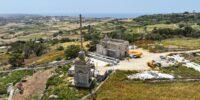
The Ġgantija complex consists of two separate temples, both wrapped in a single boundary wall and sharing a monumental forecourt. While to our modern brains, these spaces might appear as if they’re hosting just piles of rocks, to the Neolithic community they were purpose-built ceremonial spaces. They were crafted in the cloverleaf-shaped design so distinctive to Malta’s megalithic temples.
When you step inside, as you walk through via the walkways designed to protect the site, you’ll find apsidal chambers situated along a central corridor. Red ochre fragments suggest the walls were once plastered and painted. In the meantime, clever libation holes in the floor may have been used to pour offerings to the gods (or goddesses…we’ll get to that very soon).
Outside, the raised courtyard hints at a space that hosted large public rituals such as communal gatherings, feasts, and maybe even animal sacrifices, judging by the bones discovered onsite. Firepits and hearths are also scattered around, evidence that this was not a quiet monastery. It was alive with smoke, song, and ceremony.

A Fertility Cult or a Goddess Temple?
Many scholars believe Ġgantija served a fertility cult, and the numerous female shaped figurines unearthed at various Maltese temples seem to support this. Some modern visitors, including those on “Goddess tours,” refer to the two structures as the Mother and Daughter temples, evoking a spiritual lineage that resonates with contemporary goddess spirituality.
Whether it was a shrine to Earth Mother deities or simply a space for rituals of life, death, and regeneration, Ġgantija leaves no doubt: these were not mere dwellings, but they had a much deeper meaning for the Neolithic people.
From Ruin to Renaissance
Ġgantija has been impressing visitors for centuries. By the 18th century, explorers were sketching its ruins, and in 1827, British officials cleared the site. Unfortunately, this meant that they also lost invaluable materials in the process. Fortunately, more careful excavations followed in the 20th century, leading to its UNESCO World Heritage Site status in 1980.
Today, Ġgantija is the centerpiece of the Ġgantija Archaeological Park, which includes an Interpretation Centre that showcases Neolithic artifacts and offers insight into the daily lives, beliefs, and brilliance of these early islanders.
Lightweight walkways now allow you to explore the site without damaging the fragile stonework. Restoration work has ensured that Ġgantija will continue to stand tall for generations to come.

So, Why Does Ġgantija Matter?
Well to begin with, this isn’t just ancient architecture. It’s the mark left behind by a forgotten civilization. These stones tell a story of people who, despite having no written language, managed to communicate through sacred geometry, ritual design, and sheer determination. They remind us that great ideas don’t require great technology: just vision, collaboration, and belief that an idea can become reality.
So next time someone brings up the wonders of the ancient world, tell them about the temples in Gozo. Tell them that before pyramids pierced the sky, the people of Malta and Gozo were building something timeless…stone by stone.

Getting to the Ġgantija Temples
If you’re in Malta, in order to get to the Ġgantija Temples, you will need to cross to Gozo by making use of a ferry. You can either take the Gozo Ferry from Ċirkewwa, or else the Fast Ferry from Valletta. The one in Ċirkewwa allows you to cross over to Gozo by car, while the one in Valletta will only allow you to go onboard on foot. If you’re exploring the islands by bus, the Valletta Fast Ferry might be the most accessible unless you’re staying in the Northern part of the island. Once you arrive in Mġarr, Gozo’s port of arrival, you can take bus line 322 which will take you directly to the Ġgantija Temples.